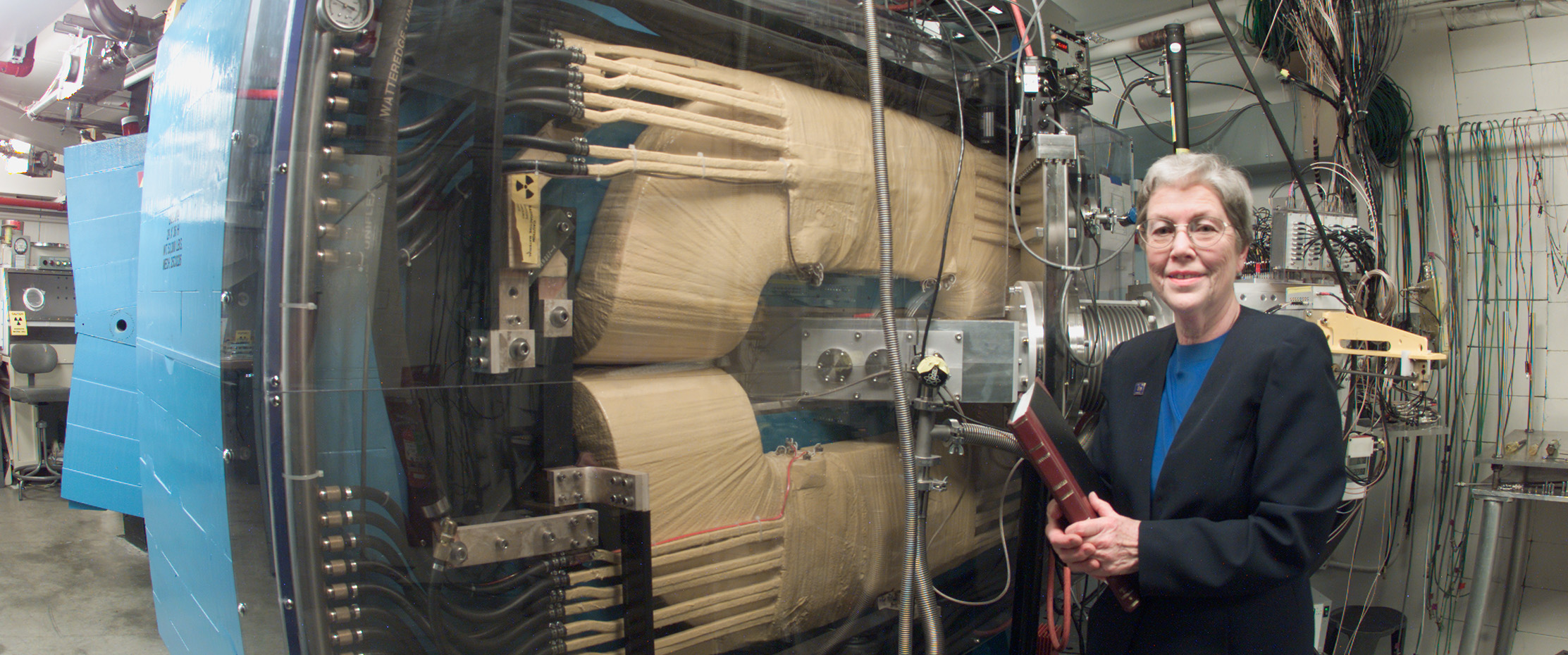
Darleane C. Hoffman, a highly esteemed nuclear chemist, passed away on September 4, 2025. Her life and career were an inspiration to many, and she notably mentored and advanced the careers of numerous young scientists in her field.
Dr. Hoffman dedicated a significant part of her career to both the Los Alamos National Laboratory (LANL) and the Lawrence Berkeley National Laboratory (LBNL). Her groundbreaking research, often utilizing LBNL’s 88-inch cyclotron, confirmed the existence of many rare heavy elements and fundamentally advanced the understanding of nuclear fission. As a trailblazer among women in her field, her work was crucial to the comprehension of radioactive elements.
Holding a Ph.D. in physical (nuclear) chemistry, Dr. Hoffman achieved several significant firsts. She was the inaugural female Division Leader of the Chemistry and Nuclear Chemistry Division at LANL. She later moved to Berkeley Lab in 1984 to lead the Heavy Element Nuclear & Radiochemistry Group. Additionally, she was a co-founder and the first director of the Seaborg Institute for Transactinium Science at the Lawrence Livermore National Laboratory.
Throughout her distinguished career, Dr. Hoffman garnered extensive recognition, including the Garvin-Olin Medal (1990), the National Medal of Science (1997), the George Hevesy Medal (2010), the Los Alamos Medal (2014), and the Enrico Fermi Presidential Award (2023). She was the first woman to receive the American Chemical Society’s (ACS’s) Award for Nuclear Chemistry and only the second woman to be honored with the Priestley Medal, the ACS’s highest accolade.
Serving as a Professor Emerita at the University of California, Berkeley, Dr. Hoffman also lent her expertise to various national committees, such as the Department of Energy’s Nuclear Energy Advisory Committee. Her career was enriched by influential fellowships, including an NSF fellowship in Norway and a Guggenheim Fellowship, during which she worked with Glenn T. Seaborg’s research group at LBNL.
Dr. Hoffman’s exceptionally distinguished career focused on nuclear science, actinide chemistry and separations, and pioneering research at the frontier of the periodic table. Her seminal work was instrumental in confirming the existence of element Seaborgium 106, named after her long-time colleague, Glenn T. Seaborg.
Dr. Hoffman’s extraordinary journey—blending pioneering science, steadfast mentorship, and quiet leadership—has left an indelible mark on every field that touched her. Her work not only expanded the boundaries of nuclear chemistry but also forged pathways for countless young scientists, especially women, to follow in her footsteps. As we honor her legacy, we remember a visionary whose discoveries, guidance, and unwavering curiosity continue to inspire the next generation of explorers of the periodic table. Her memory lives on in the minds she shaped, the elements she unveiled, and the enduring quest for knowledge that she helped propel forward.
Honoring the Legacy Of Darleane C. Hoffman